
Introduction
Website speed is one of the most important parts of online success. Whether you run a blog, business website, SEO tool website, affiliate site, or online service platform, your visitors expect pages to load fast. If your website is slow, users may leave before reading your content. This can increase bounce rate, reduce engagement, and hurt your search engine performance.
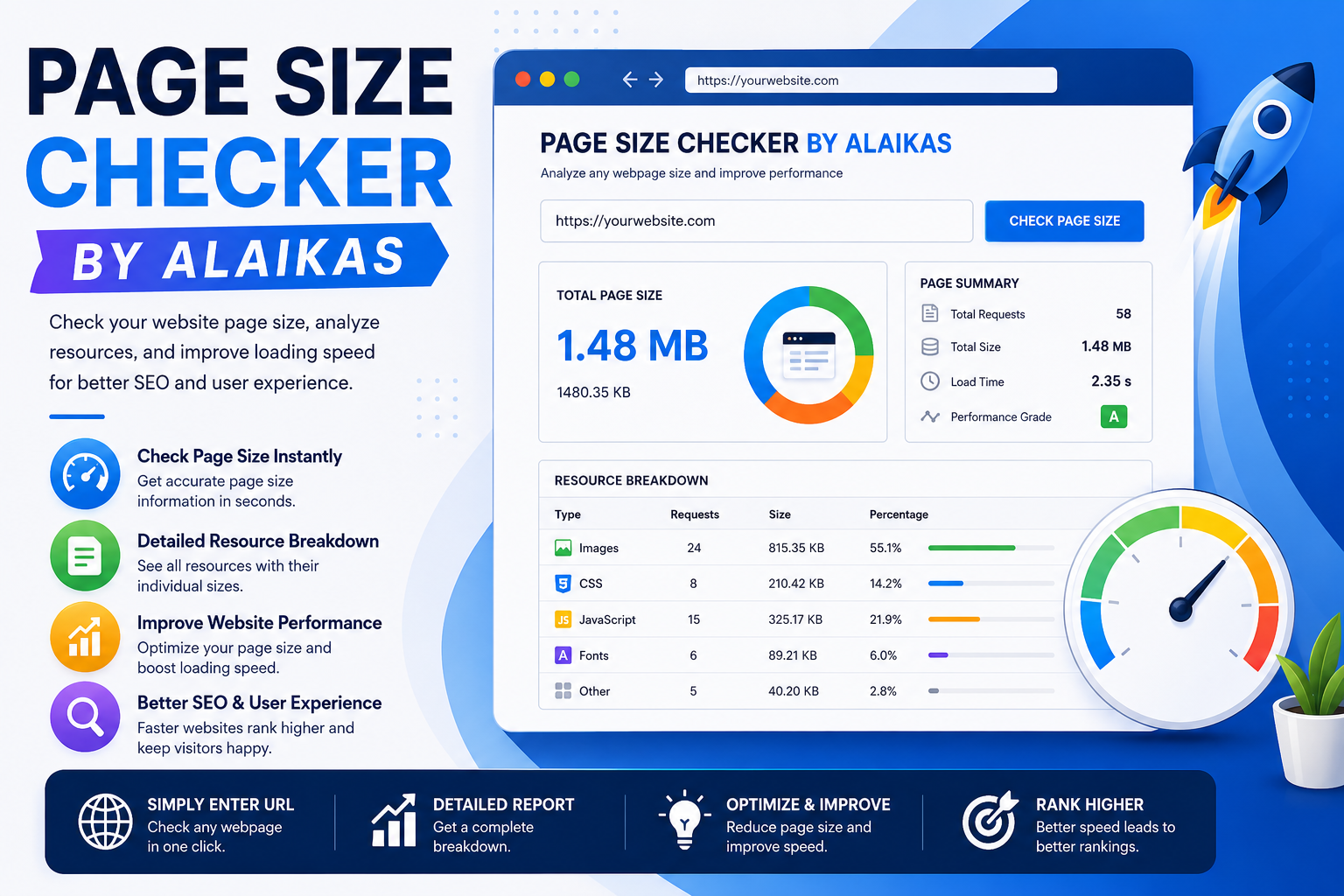
One of the key reasons behind a slow website is large page size. A web page with heavy images, unnecessary scripts, large CSS files, bulky fonts, or too many elements can take longer to load. This is where a tool like page size checker by alaikas becomes useful.
A page size checker by alaikas helps you understand how heavy your webpage is. It gives you an idea of how much data loads when someone opens your URL. By checking page size, website owners can find problems, optimize content, and improve performance.
If you want to analyze your website and make it faster, using a simple and helpful tool like page size checker by alaikas can be a smart step. It helps beginners, bloggers, developers, and SEO professionals understand page weight and improve website speed.
In this complete guide, you will learn what page size means, why it matters for SEO, how a page size checker works, and how to reduce page size for better performance.
What Is Page Size?
Page size means the total amount of data a browser needs to download to open a webpage. This includes all the files and elements used on that page.
A webpage may include:
- HTML code
- CSS files
- JavaScript files
- Images
- Videos
- Fonts
- Icons
- Tracking scripts
- Ads
- Plugins
- Third-party widgets
When someone visits your website, their browser downloads these files. If the total file size is too large, the page may load slowly.
For example, a simple text-based page may load quickly because it has a small page size. But a page with large images, sliders, videos, and many scripts may take longer because it has a bigger size.
What Is Page Size Checker by Alaikas?
Page size checker by alaikas is a keyword related to a web tool that helps users check the size of a webpage. It can be useful for people who want to analyze website performance and understand how heavy their pages are.
A page size checker usually allows you to enter a URL and get information about the total page size. Some tools may also show details about individual files, such as images, scripts, stylesheets, and other resources.
The main purpose of a page size checker is simple: it helps you find out whether your webpage is lightweight or too heavy.
A tool like page size checker by alaikas can be helpful for:
- Bloggers
- SEO experts
- Website owners
- Web developers
- Digital marketers
- Students learning SEO
- Business website managers
- WordPress users
By knowing your page size, you can take steps to improve speed, user experience, and search visibility.
Why Page Size Matters for Website Performance
Page size directly affects how fast your website loads. A smaller page usually loads faster, while a larger page often takes more time.
Faster Pages Improve User Experience
Users do not like waiting. If a page takes too long to load, many visitors leave and go to another website.
A fast-loading website gives users a smoother experience. They can read content, browse pages, and take action without frustration.
Large Pages Can Increase Bounce Rate
Bounce rate means the percentage of users who leave your website after viewing only one page. If your site loads slowly, users may leave before the page opens properly.
A high bounce rate can send negative signals about user experience.
Page Size Affects Mobile Users
Many visitors use mobile data. Large web pages can load slowly on mobile networks, especially in areas with weak internet speed.
A lightweight page is better for mobile users because it loads faster and uses less data.
Better Speed Can Support SEO
Search engines want to show users helpful and fast websites. While content quality is very important, page experience and loading performance also matter.
Reducing page size checker by alaikas can help improve your site’s technical SEO.
How Page Size Affects SEO
SEO is not only about keywords and backlinks. Technical performance also plays an important role. Page size is connected to website speed, crawling, indexing, and user engagement.
1. Page Speed and Rankings
Fast-loading pages can give users a better experience. Search engines consider page experience as part of overall website quality.
If two pages have similar content quality, the faster and better-performing page may have an advantage.
2. Crawl Efficiency
Search engines use bots to crawl websites. If your pages are too heavy or slow, crawling may become less efficient.
A lightweight website can make it easier for search engines to crawl and understand your content.
3. Better User Signals
When users stay longer on your website, read content, and visit more pages, it can show that your website is useful.
A fast page can help improve engagement because users can access content quickly.
4. Mobile SEO
Google and other search engines focus strongly on mobile experience. Since many users browse from mobile phones, page size matters even more.
A mobile-friendly and lightweight page can support better SEO performance.
Common Reasons Behind Large Page Size
Many website owners do not realize why their pages are heavy. Usually, page size increases because of unnecessary or unoptimized elements.
Large Images
Images are often the biggest reason behind large page size. If you upload images directly from a camera or design tool without compression, they may be too large.
For example, an image of 3 MB can slow down a page, especially if several large images are used.
Too Many Plugins
WordPress websites often become slow because of too many plugins. Some plugins add CSS, JavaScript, fonts, or tracking scripts to every page.
Even if a plugin is useful, using too many can increase page size.
Heavy JavaScript Files
JavaScript adds interactive features to websites. But too much JavaScript can slow down loading and increase page weight.
Examples include:
- Sliders
- Popups
- Animation scripts
- Chat widgets
- Tracking tools
- Ad scripts
Unused CSS
Many themes and plugins load CSS files even when they are not needed on a specific page. This increases page size and affects speed.
Web Fonts
Custom fonts can make a website look attractive, but loading many font styles and weights can increase page size.
Use only the fonts you really need.
Videos and Embedded Content
Videos, maps, social media embeds, and external widgets can add extra weight to a page.
If used carefully, they can improve content. But overusing them can hurt performance.
Benefits of Using Page Size Checker by Alaikas
A page size checker is useful because it gives you a clear understanding of your website’s weight. Without checking page size, you may not know what is slowing down your site.
Helps Identify Heavy Pages
Some pages may be heavier than others. For example, your homepage may have sliders and many images, while your blog post pages may be lighter.
A checker helps you identify which pages need optimization.
Improves Website Speed
Once you know your page size, you can reduce unnecessary weight and improve loading speed.
Supports SEO Audits
SEO professionals often check page size during technical audits. It helps them understand performance issues and recommend improvements.
Better Mobile Experience
By reducing page size, you make your website easier to load on mobile devices.
Saves Bandwidth
Smaller pages use less data. This is helpful for users and can also reduce server bandwidth usage.
Improves Conversion Rate
A faster website can improve conversions. If users can quickly access your content or service page, they are more likely to take action.
How to Use a Page Size Checker Tool
Using a page size checker is usually simple. Most tools follow a basic process.
Step 1: Copy Your Page URL
First, choose the webpage you want to check. It can be your homepage, blog post, service page, or landing page.
Step 2: Paste the URL
Paste the URL into the page size checker tool.
Step 3: Run the Test
Click the button to start the checking process. The tool will analyze the page and calculate its size.
Step 4: Review the Result
The tool may show total page size and sometimes details about different resources.
Step 5: Optimize Your Page
After checking the result, reduce heavy files, compress images, remove unused scripts, and improve loading speed.
What Is a Good Page Size?
There is no single perfect page size for every website. It depends on the type of page, content, and purpose.
However, a smaller page is usually better for speed.
As a general rule:
- Simple blog posts should be lightweight
- Landing pages should load fast
- Homepages should avoid unnecessary heavy elements
- Image-heavy pages should use compressed images
- Mobile pages should be carefully optimized
If your page size is too large, try reducing it step by step.
How to Reduce Website Page Size
Reducing page size is one of the best ways to improve speed. You do not need to be an expert developer to make basic improvements.
1. Compress Images
Images should be compressed before uploading. You can use image compression tools to reduce file size without losing much quality.
Best practices include:
- Use WebP format when possible
- Resize images before uploading
- Avoid uploading very large images
- Use lazy loading for images
- Add proper alt text
2. Remove Unnecessary Plugins
If you use WordPress, check your plugins regularly. Delete plugins you do not use.
Too many plugins can slow down your website and increase page size.
3. Minify CSS and JavaScript
Minification removes unnecessary spaces and characters from code files. This makes files smaller and faster to load.
Many speed optimization plugins can minify CSS and JavaScript automatically.
4. Use Browser Caching
Caching helps browsers store website files temporarily. When users visit again, the page can load faster.
Caching can reduce server load and improve user experience.
5. Use a Content Delivery Network
A CDN stores website files on servers in different locations. This helps users load your website faster from the nearest server.
6. Avoid Too Many Fonts
Use limited font styles. Avoid loading many font weights such as 300, 400, 500, 600, 700, and 900 if you do not need them.
7. Reduce Third-Party Scripts
Third-party scripts can slow down your site. These may include:
- Chat tools
- Analytics tools
- Ads
- Social media widgets
- Tracking pixels
- External forms
Use only necessary scripts.
8. Use Lazy Loading
Lazy loading means images and videos load only when users scroll near them. This can reduce initial page load size.
9. Optimize Homepage Design
Many websites have heavy homepages with large sliders, videos, animations, and many sections. Keep your homepage clean and focused.
10. Clean Your Theme
A lightweight theme can improve speed. Avoid using themes that load too many unnecessary files.
Page Size Checker for WordPress Websites
WordPress is popular because it is easy to use. But WordPress websites can become heavy if not managed properly.
A WordPress site may have large page size because of:
- Heavy themes
- Too many plugins
- Large featured images
- Page builder scripts
- Sliders
- Popups
- Ads
- Custom fonts
Using page size checker by alaikas can help WordPress users understand which pages need improvement.
WordPress Optimization Tips
To reduce WordPress page size:
- Use a lightweight theme
- Compress images
- Remove unused plugins
- Use caching
- Minify CSS and JavaScript
- Avoid heavy page builders when not needed
- Use optimized hosting
- Enable lazy loading
- Clean database regularly
These steps can make a WordPress site faster and more SEO-friendly.
Page Size and Core Web Vitals
Core Web Vitals are performance signals related to user experience. Page size can affect these metrics.
Largest Contentful Paint
Largest Contentful Paint measures how quickly the main content loads. Large images or heavy scripts can make this slower.
Interaction to Next Paint
This measures how quickly a page responds when users interact with it. Heavy JavaScript can affect this.
Cumulative Layout Shift
This measures visual stability. Poorly optimized images, ads, and fonts can cause layout shifts.
Reducing page size can help improve Core Web Vitals and create a better user experience.
Page Size Checker for Bloggers
Bloggers often focus on writing content, but technical SEO is also important. If a blog post is slow, readers may leave quickly.
A page size checker helps bloggers:
- Check blog post weight
- Find heavy images
- Improve loading speed
- Make content mobile-friendly
- Support SEO performance
- Improve reader experience
For bloggers, every post should be clean, readable, and fast.
Page Size Checker for SEO Experts
SEO experts use many tools during website audits. Page size checking is one of the useful steps.
An SEO expert may check page size to:
- Identify speed problems
- Compare pages
- Improve technical SEO
- Reduce bounce rate
- Optimize landing pages
- Improve mobile performance
A tool like page size checker by alaikas can fit naturally into an SEO audit workflow.
Page Size Checker for Developers
Developers also benefit from page size tools. They can use results to improve frontend performance.
Developers may focus on:
- Reducing CSS files
- Optimizing JavaScript
- Using clean code
- Removing unused libraries
- Compressing assets
- Improving server response
- Applying performance best practices
A smaller page size helps developers create faster and cleaner websites.
Best Practices for Keeping Page Size Low
Keeping page size low should be part of your regular website maintenance.
Follow these best practices:
- Compress every image before uploading
- Use simple and clean design
- Avoid unnecessary animations
- Use only important plugins
- Remove unused code
- Limit external scripts
- Choose good hosting
- Use caching
- Check page size regularly
- Update old pages
These habits can keep your website healthy and fast.
Mistakes to Avoid When Optimizing Page Size
While optimizing page size, avoid common mistakes that can damage your website.
Removing Important Files
Do not remove files without knowing their purpose. Some files may be needed for design or functionality.
Over-Compressing Images
Too much compression can make images look blurry. Keep a balance between quality and size.
Using Too Many Optimization Plugins
Using multiple speed plugins together can cause conflicts. Choose one reliable tool and configure it properly.
Ignoring Mobile Testing
Always check your website on mobile. A page may look fine on desktop but perform poorly on mobile.
Not Testing After Changes
After optimization, test your website again. Make sure everything still works correctly.
Why Page Size Checker by Alaikas Is Useful for Beginners
Beginners often find technical SEO confusing. They may not understand coding, scripts, or website performance metrics.
A simple page size checker can make things easier by showing clear results. Once beginners know their page size, they can start improving basic issues.
It is useful because it helps answer questions like:
- Is my page too heavy?
- Why is my website slow?
- Do I need to compress images?
- Should I remove some plugins?
- Is my homepage bigger than my blog posts?
This makes page size checker by alaikas a helpful starting point for website optimization.
How Often Should You Check Page Size?
You should check page size regularly, especially when making changes to your website.
Check page size:
- After publishing a new post
- After changing your theme
- After adding plugins
- After uploading large images
- After adding ads
- After redesigning your homepage
- During SEO audits
- Before launching a landing page
Regular checking helps prevent performance problems.
Page Size, Website Design, and Branding
Some website owners think a beautiful design must be heavy. But a professional website can be attractive and fast at the same time.
Good design should balance:
- Visual quality
- Speed
- User experience
- Mobile performance
- SEO needs
A clean design often performs better than a crowded design. Use images, colors, and elements carefully.
Final Checklist Before Publishing a Web Page
Before publishing any important page, use this checklist:
- Is the page size reasonable?
- Are images compressed?
- Is the page mobile-friendly?
- Are unnecessary plugins avoided?
- Is the content easy to read?
- Are headings properly structured?
- Is the meta title added?
- Is the meta description added?
- Are internal links included?
- Is the page loading fast?
This checklist can help improve both user experience and SEO.
Conclusion
Page size is an important part of website performance, SEO, and user experience. A heavy webpage can load slowly, frustrate users, increase bounce rate, and reduce search visibility. On the other hand, a lightweight and optimized page can load faster, perform better on mobile, and provide a smoother experience.
Using a tool like page size checker by alaikas can help website owners, bloggers, developers, and SEO experts understand how heavy a page is. Once you know your page size, you can take smart steps such as compressing images, removing unnecessary scripts, reducing plugins, enabling caching, and improving overall performance.
If you want to build a faster and more SEO-friendly website, checking page size should be part of your regular website audit. A helpful resource like page size checker by alaikas can guide you toward better speed, better usability, and stronger online growth.
A fast website is not just good for search engines. It is good for real users. And when users enjoy your website, your chances of ranking, growing, and converting visitors become much stronger.
FAQs
1. What is page size checker by alaikas?
Page size checker by alaikas is a keyword related to a tool or resource that helps users check the total size of a webpage and understand how heavy it is.
2. Why is page size important for SEO?
Page size affects website loading speed, mobile performance, user experience, and technical SEO. Smaller and optimized pages usually load faster.
3. What causes a webpage to become too large?
Large images, too many plugins, heavy JavaScript, unused CSS, videos, ads, fonts, and third-party scripts can increase webpage size.
4. How can I reduce my website page size?
You can reduce page size by compressing images, minifying CSS and JavaScript, using caching, removing unused plugins, limiting fonts, and reducing third-party scripts.
5. How often should I check my page size?
You should check page size after publishing new content, adding plugins, changing design, uploading large images, or during regular SEO audits.
