
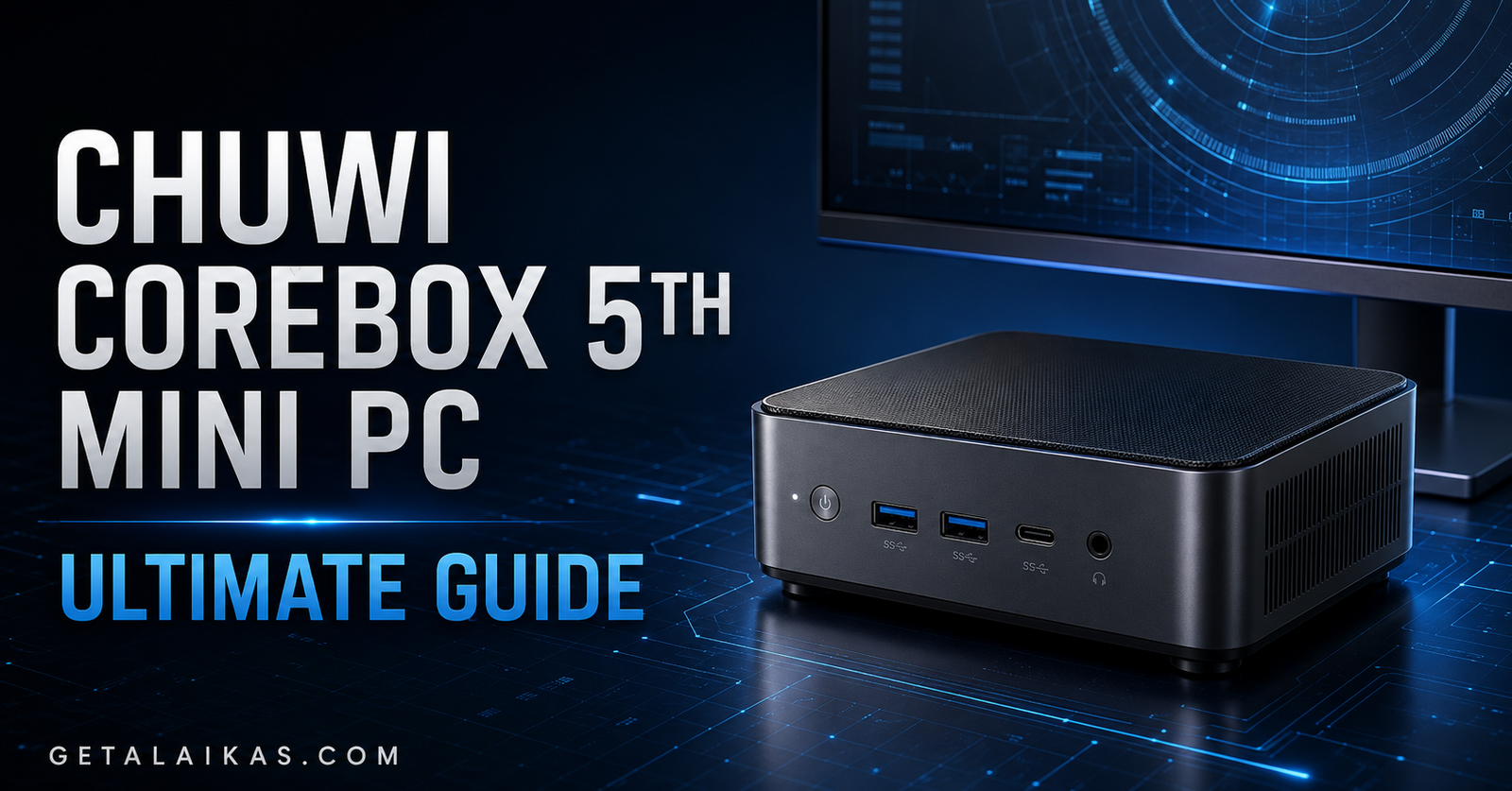
The desktop computer is no longer limited to a large tower that occupies half of your workspace. Modern mini PCs can provide strong everyday performance, flexible connectivity, and practical upgrade options in a body small enough to fit on a crowded desk. The CHUWI CoreBox 5th is a good example of this changing approach to personal computing.
Powered by a 13th-generation Intel Core i5 processor, the CoreBox 5th is designed for users who want more processing power than a basic entry-level mini PC can offer. It combines a compact chassis with DDR5 memory, solid-state storage, wireless connectivity, and support for high-resolution displays.
If you searched for the ultimate guide to CHUWI CoreBox 5th Mini PC Alaikas, this detailed resource explains its specifications, real-world uses, gaming capability, upgrade potential, connectivity, advantages, and limitations. It will also help you decide whether this compact computer is suitable for your home, office, creative work, or entertainment setup.
What Is the CHUWI CoreBox 5th Mini PC Alaikas?
The CHUWI CoreBox 5th is a small-form-factor Windows computer built around Intel’s Core i5-13500H processor. Instead of using a low-power entry-level chip commonly found in inexpensive mini PCs, it uses a performance-focused H-series mobile processor.
This gives the CoreBox 5th enough processing ability for more demanding workloads, including:
- Office applications and web-based platforms
- Heavy browser multitasking
- Programming and software development
- Photo editing
- Light-to-moderate video editing
- Online classes and remote work
- Business management software
- Media streaming
- Casual and competitive gaming
- Multi-monitor productivity
CHUWI positions the CoreBox 5th as a compact alternative to a conventional desktop. It is considerably smaller than a standard tower but can still connect to monitors, keyboards, storage devices, printers, speakers, and other desktop accessories.
Its main appeal is straightforward: users receive capable PC hardware without sacrificing a large amount of desk space.
CHUWI CoreBox 5th Specifications at a Glance
The CoreBox 5th is generally advertised with the following core configuration:
| Component | Published specification |
|---|---|
| Processor | 13th Gen Intel Core i5-13500H |
| CPU design | 12 cores and 16 threads |
| Maximum turbo speed | Up to 4.7 GHz |
| Cache | 18MB Intel Smart Cache |
| Memory | 16GB DDR5 |
| Memory speed | Up to 4800MHz in the advertised configuration |
| Storage | 512GB PCIe M.2 SSD |
| Operating system | Windows 11 |
| Wireless connection | Wi-Fi 6 |
| Bluetooth | Bluetooth 5.x, depending on configuration |
| Wired networking | Gigabit or 2.5-gigabit Ethernet, depending on version |
| Display support | Up to 4K at 60Hz |
| Main USB ports | Four USB-A 3.0 ports |
| Audio | 3.5mm audio connections |
| Dimensions | Approximately 173 × 158 × 73mm |
| Weight | Approximately 930 grams on the current specification page |
| Power input | 19V/4.74A adapter |
The Core i5-13500H itself has four performance cores, eight efficient cores, 16 threads, an 18MB cache, and a maximum turbo frequency of 4.7GHz. These processor details are confirmed by Intel’s official specification page.
An Important Configuration Warning
CHUWI’s current online pages contain some inconsistencies. Its CoreBox overview advertises Iris Xe-class graphics, dual-channel DDR5 memory, 2.5-gigabit Ethernet, and four display outputs. However, another official specification page lists Intel UHD Graphics, one HDMI output, one DisplayPort, Gigabit Ethernet, Bluetooth 5.1, and fewer total display connections.
Therefore, buyers should not rely only on the product name. Check the exact processor, graphics label, port layout, memory arrangement, networking hardware, and model number shown by the seller. Product configurations can vary by market, production batch, or retailer.
Compact Design and Build Quality
The CoreBox 5th is larger than some ultra-small mini PCs, but it remains significantly smaller than a traditional desktop tower. Its approximately 173 × 158mm footprint allows it to sit beside a monitor without dominating the workspace.
CHUWI uses a combination of aluminium-magnesium alloy and polycarbonate in the chassis. The black and space-grey finish gives it a clean appearance that should fit naturally in an office, bedroom, classroom, studio, or reception environment.
Its design provides several practical benefits:
- It leaves more room for notebooks and accessories.
- It can be moved between workspaces more easily than a desktop tower.
- It requires fewer large cables than a traditional desktop setup.
- It can create a cleaner and more professional-looking desk.
- It is convenient for shared offices and temporary workstations.
At around 930 grams, it is reasonably portable, although it is not a complete portable system like a laptop. You must still carry the power adapter, display, keyboard, and mouse or connect it to accessories available at your destination.
The slightly larger chassis may actually benefit performance. Extremely tiny computers have limited room for heat pipes, fans, and airflow. The CoreBox’s dimensions allow CHUWI to install a more substantial active cooling system.
Intel Core i5-13500H Performance
The Core i5-13500H is the most important feature of the CoreBox 5th. It is a 13th-generation H-series processor originally designed for performance-oriented laptops and compact systems.
Its hybrid architecture combines two types of cores:
Performance Cores
The four performance cores are designed for heavier and time-sensitive workloads. They handle demanding applications, active software, and tasks that require strong single-core speed.
These cores are useful when:
- Opening large spreadsheets
- Editing photos
- Compiling code
- Running design applications
- Processing compressed files
- Using business software
- Editing video projects
Efficient Cores
The eight efficient cores handle background operations and parallel workloads with lower power requirements. They allow Windows to manage updates, browser tabs, cloud synchronization, messaging apps, and other background processes without placing every task on the performance cores.
Together, the 12 cores and 16 threads provide excellent multitasking potential for a mini PC. You can attend a video meeting while using a browser, editing a document, downloading files, and running a communication app without immediately overwhelming the processor.
The chip can reach up to 4.7GHz under suitable power and temperature conditions. However, maximum turbo speed is not constant. Actual performance depends on cooling, system power settings, workload duration, room temperature, and firmware configuration.
Everyday Productivity Experience
For ordinary computing, the CoreBox 5th offers more performance than many users need. Windows 11, office applications, browsers, and communication software should feel responsive when the system is correctly configured.
The 16GB of DDR5 memory is particularly important for modern multitasking. Many users now keep numerous browser tabs open while using Microsoft Office, cloud storage, email, social media management tools, and messaging platforms. An 8GB system can struggle under that workload, while 16GB provides noticeably more breathing room.
The CoreBox 5th is suitable for:
- Microsoft Word, Excel, and PowerPoint
- Google Docs and Google Sheets
- Zoom, Microsoft Teams, and Google Meet
- WordPress management
- Search engine optimization tools
- Social media scheduling
- Customer relationship management platforms
- Accounting applications
- Web research
- Basic database work
- Online learning systems
For website owners and digital professionals, it can comfortably support common tasks such as content publishing, keyword research, image optimization, analytics monitoring, and campaign management. Readers can explore more practical technology content through Getalaikas.com.
Graphics Performance and Gaming
Graphics are one of the most easily misunderstood parts of the CoreBox 5th. This mini PC uses the integrated graphics built into the Intel processor rather than a dedicated NVIDIA or AMD graphics card.
Integrated graphics share system memory and power with the CPU. They are efficient and compact, but they are not intended to replace a powerful gaming GPU.
Depending on the exact memory configuration and product version, the graphics may be presented as Intel Iris Xe-eligible graphics or Intel UHD Graphics. Intel’s branding and performance can depend on how the manufacturer configures the memory and system.
Games It Can Handle
The CoreBox 5th is most suitable for:
- Competitive esports games
- Older PC titles
- Indie games
- Strategy games
- Lightweight racing games
- Emulation within legal software and game ownership rules
- Casual games from established PC stores
Games such as League of Legends, Dota 2, Valorant, Minecraft, and older action titles should be more realistic targets than demanding modern games played at maximum settings.
CHUWI publishes gaming results for several titles on its official CoreBox 5th overview, but manufacturer benchmarks should be treated as reference figures rather than guaranteed results. Frame rates vary with resolution, graphics settings, game updates, drivers, memory configuration, cooling, and background activity.
What It Cannot Replace
The CoreBox 5th should not be purchased as a direct replacement for a desktop containing a powerful dedicated graphics card. It is not the ideal choice for:
- New AAA games at high or ultra settings
- Professional 3D animation
- Complex architectural rendering
- Advanced visual-effects production
- High-resolution game streaming
- GPU-heavy artificial intelligence workloads
- Competitive gaming at very high frame rates
Lowering a game to 720p or 1080p with low settings may improve performance. Nevertheless, buyers whose primary goal is modern gaming should consider a larger system with dedicated graphics.
DDR5 Memory and Multitasking
The standard CoreBox 5th configuration includes 16GB of DDR5 memory. CHUWI advertises a dual-channel arrangement on its main overview page.
Dual-channel memory is especially valuable in a system using integrated graphics because the CPU and GPU share the available memory bandwidth. A correctly installed dual-channel configuration can improve both general responsiveness and graphics performance compared with a single memory module of similar capacity.
DDR5 also provides higher bandwidth than the DDR4 memory commonly used in older mini PCs. The practical benefits may include:
- Faster switching between applications
- Better performance with many browser tabs
- Improved integrated graphics performance
- Smoother handling of large files
- More responsive creative applications
- Better performance during parallel workloads
Sixteen gigabytes is sufficient for most home, office, student, and general business users. People who work with large video projects, virtual machines, databases, or advanced development environments may eventually benefit from more memory.
Before buying additional RAM, confirm the number of available slots, supported capacity, required DDR5 SO-DIMM speed, and warranty conditions for your exact unit.
SSD Storage and Upgrade Potential
A 512GB PCIe M.2 SSD is included in the commonly advertised model. Solid-state storage provides faster startup, application loading, searching, and file transfers than a mechanical hard drive.
A 512GB drive is practical for Windows, office software, browser data, and a moderate collection of documents. However, usable space will be lower after accounting for Windows, recovery data, updates, and installed programs.
Storage can become limited if you keep:
- Large video libraries
- Modern PC games
- High-resolution photos
- Raw camera files
- Virtual machines
- Local backups
- Large project folders
CHUWI’s published specification identifies M.2 2280 SSD expandability, though the exact supported capacity should be checked for the individual unit. The current specification page mentions support up to 1TB, while product information may differ across revisions.
Users who need more space can also connect an external SSD, hard drive, or network-attached storage system. An external drive is the simpler option for people who do not want to open the computer.
Always back up important data before replacing an internal SSD. Opening the chassis or installing unsupported components could also affect warranty coverage.
Cooling System and Noise
Placing a powerful processor inside a small enclosure creates a major challenge: heat. If a compact computer cannot remove heat efficiently, performance may decline during long workloads.
CHUWI addresses this with an active cooling system that reportedly includes:
- Four heat pipes
- An aluminium heat sink
- A 55-fin cooling structure
- An approximately 8cm fan
- A hydraulic-bearing fan design
- Fan speeds of around 3,400 RPM under specified conditions
The company reports a noise level of approximately 33dBA in its own test environment. Real-world noise will vary according to room temperature, fan profile, dust buildup, background processes, and workload intensity.
During light browsing or document editing, the cooling system should not need to operate at its highest speed continuously. During video exports, gaming, code compilation, or other sustained tasks, the fan will become more noticeable.
For the best thermal performance:
- Keep the air vents uncovered.
- Do not place the computer on thick fabric.
- Leave space around the chassis.
- Clean external vents carefully when dust accumulates.
- Avoid positioning it directly beside a heater.
- Install operating-system and firmware updates from official sources.
- Do not attempt risky cooling modifications.
A compact computer should be positioned where fresh air can enter and warm air can escape.
Ports and Connectivity
A mini PC is only useful as a desktop replacement if it can connect to essential accessories. The CoreBox 5th provides multiple USB-A ports, display connections, audio support, Ethernet, Wi-Fi, and Bluetooth.
USB Connectivity
Four USB-A 3.0 ports provide connections for:
- Keyboard and mouse
- External storage
- Printer or scanner
- Webcam
- Microphone
- USB headset
- Card reader
- Mobile device cable
- USB hub
Users with newer USB-C accessories should check the exact listing carefully. Do not assume the system includes a full-featured USB-C or Thunderbolt port unless it is clearly shown in the specifications for that model.
Display Connectivity
CHUWI’s main marketing page advertises up to four 4K displays using two HDMI 2.0 and two DisplayPort 1.4 connections. In contrast, its separate specification page lists one HDMI and one DisplayPort connection.
This is another reason to inspect seller photographs and written specifications before ordering. The number and type of physical display ports are easy to verify visually and can differ between revisions.
Even a dual-monitor configuration can significantly improve productivity. One screen can display the active document while another shows research, analytics, email, communication software, or a preview window.
Wired and Wireless Networking
Wi-Fi 6 can deliver fast wireless networking when paired with a compatible router. Bluetooth allows the computer to connect to wireless keyboards, mice, headphones, and speakers.
The advertised Ethernet capability also varies between official pages. Some material references 2.5-gigabit Ethernet, while another specification lists Gigabit Ethernet. Users buying the CoreBox for a high-speed local network should confirm the Ethernet controller and port rating.
A wired connection is generally preferred for large file transfers, office networks, low-latency online activity, and stable video meetings.
Multi-Monitor Work and 4K Entertainment
High-resolution display support is one of the CoreBox 5th’s most attractive features. The system is advertised for 4K output at up to 60Hz, which makes it suitable for office monitors, compatible televisions, and digital displays.
A 4K monitor offers additional workspace for:
- Large spreadsheets
- Side-by-side documents
- Editing timelines
- Programming windows
- Web design previews
- Analytics dashboards
- High-resolution photographs
The CoreBox can also serve as a home media computer. It can connect to a television for streaming, local video playback, web browsing, presentations, and family photo viewing.
However, supporting 4K video output does not mean every game will run smoothly at 4K. Video playback and desktop display output are much less demanding than rendering a modern 3D game.
Creative Work and Content Production
The Core i5-13500H gives the CoreBox 5th enough CPU performance for many creative applications. It can be useful for bloggers, social media managers, photographers, and beginner video creators.
Suitable creative workloads include:
- Canva designs
- Basic Photoshop projects
- Image resizing and compression
- Short 1080p video projects
- Simple audio editing
- WordPress content creation
- Presentation design
- Basic vector graphics
- Thumbnail creation
- Light photo correction
The integrated graphics and 16GB memory remain the main limitations. Large 4K video timelines, complex visual effects, advanced 3D projects, and professional rendering may require a dedicated GPU and additional RAM.
Content creators should also consider the amount of storage they need. Video and raw image files can fill a 512GB SSD quickly, making external storage or an internal upgrade important.
Is It Good for Business and Education?
The CoreBox 5th is a strong candidate for business and educational environments because it combines compact size with capable processing.
Business Uses
It can be used for:
- Reception and front-desk systems
- Inventory management
- Point-of-information displays
- Administrative work
- Online meetings
- Customer support
- Digital marketing
- Website management
- Accounting and invoices
- Multi-monitor office setups
Its small size makes it easier to deploy in offices where desk space is limited.
Student Uses
Students can use it for:
- Online classes
- Research
- Assignments
- Presentations
- Educational videos
- Beginner programming
- Web development
- Graphic design practice
- General communication
Unlike a laptop, it does not include a display, keyboard, trackpad, speakers, or battery. A student who frequently travels between home and school may therefore find a laptop more convenient. For a fixed study desk, the CoreBox can offer a comfortable desktop experience.
Initial Setup Guide
Setting up the CoreBox 5th should be straightforward:
- Place the computer on a stable surface with space around its vents.
- Connect a monitor using HDMI or DisplayPort.
- Attach a keyboard and mouse through USB or Bluetooth.
- Connect the official power adapter.
- Turn on the monitor and then start the mini PC.
- Complete the Windows 11 setup.
- Connect to Wi-Fi or Ethernet.
- Run Windows Update.
- Check CHUWI’s official support resources for relevant drivers.
- Create a recovery option and backup important files.
Avoid downloading drivers from unknown third-party websites. Incorrect drivers can cause wireless, audio, display, or stability problems.
After setup, remove unnecessary startup applications and install only the programs you actually use. This helps maintain responsive performance.
Advantages of the CHUWI CoreBox 5th
The strongest qualities of this mini PC include:
- Powerful 12-core Intel Core i5-13500H processor
- Compact and attractive chassis
- 16GB of modern DDR5 memory
- Fast PCIe solid-state storage
- Windows 11 support
- Wi-Fi 6 connectivity
- Multiple USB connections
- High-resolution display support
- Upgradeable internal storage
- Good potential for office multitasking
- Suitable for light creative work
- More desk space than a full-size tower requires
It offers an appealing balance between compact dimensions and processing capability.
Potential Drawbacks
No mini PC is ideal for every user. The CoreBox 5th has several limitations buyers should understand:
- Integrated graphics limit demanding gaming and 3D work.
- The standard 512GB SSD may be too small for large media collections.
- It is less portable than a complete laptop.
- Active cooling produces some fan noise under load.
- It lacks the expansion flexibility of a full desktop tower.
- Official pages show inconsistent graphics, ports, networking, and weight details.
- Local warranty and repair availability may vary.
- A monitor, keyboard, and mouse may need to be purchased separately.
- Some accessories may require a USB-C adapter or hub.
The inconsistent official specifications are especially important. Buyers should obtain written confirmation from the seller when a particular port or feature is essential.
Who Should Buy the CoreBox 5th?
The CoreBox 5th is best suited to people who:
- Want a powerful compact office PC
- Already own a monitor and accessories
- Need strong multitasking performance
- Use several productivity applications
- Want a clean desk setup
- Perform light photo or video editing
- Play casual or esports games
- Need a home media computer
- Want more power than an entry-level processor provides
It may not be the right choice for people who:
- Need a highly portable all-in-one computer
- Want maximum modern gaming performance
- Depend on professional 3D rendering
- Require internal expansion cards
- Need several large internal drives
- Prefer easily available local replacement parts
- Require a guaranteed Thunderbolt connection
What to Check Before Buying
Before purchasing, verify the following details with the retailer:
- Exact Intel processor model
- Installed graphics name
- Number of RAM modules
- Total RAM capacity
- Available memory slots
- SSD type and capacity
- Maximum supported internal storage
- Number of HDMI and DisplayPort connections
- Ethernet speed
- Wi-Fi and Bluetooth versions
- Windows edition and activation status
- Power-plug type
- Warranty duration
- Local return policy
- Items included in the box
Prices and configurations can change, so compare the exact model rather than choosing only according to the lowest advertised price.
Conclusion
The CHUWI CoreBox 5th is a capable compact computer built for users who value strong CPU performance, modern memory, fast storage, and a space-saving design. Its Intel Core i5-13500H processor provides a major advantage over basic mini PCs using low-power entry-level chips.
For office work, research, web management, education, content publishing, media playback, and moderate creative tasks, it offers a useful combination of power and convenience. It can also handle casual gaming, although integrated graphics prevent it from competing with a dedicated gaming desktop.
Its most significant concern is not the processor but the variation between published specifications. Buyers should confirm the graphics configuration, physical display ports, Ethernet speed, memory arrangement, and upgrade limits of the exact unit being sold.
When the verified configuration matches your needs, the CoreBox 5th can be a practical alternative to a bulky desktop tower and a valuable addition to a modern workspace.
Frequently Asked Questions
Is the CHUWI CoreBox 5th good for gaming?
It is suitable for esports, indie games, older titles, and casual gaming at reasonable settings. It is not designed to replace a dedicated gaming PC for demanding modern games at high resolutions or maximum graphics settings.
Can the storage be upgraded?
The CoreBox 5th uses M.2 2280 SSD storage and is designed to provide some storage upgrade flexibility. Check the capacity limit and compatible SSD specification for your exact unit before purchasing an upgrade.
Does the CoreBox 5th support 4K monitors?
Yes, CHUWI advertises 4K output at up to 60Hz. However, the number of simultaneous displays may depend on the physical ports included with the specific version.
Is 16GB of DDR5 RAM enough?
Sixteen gigabytes is enough for general office work, web browsing, online classes, programming, content management, and light creative applications. Advanced video projects, virtual machines, and large professional workloads may benefit from more memory.
Can the CoreBox 5th replace a desktop computer?
It can replace a conventional desktop for most home, office, education, media, and general productivity tasks. Users who require a dedicated graphics card, multiple internal drives, or PCIe expansion cards should choose a traditional desktop tower instead.
